Theatre Festivals of the Medici
a scholarly essay by
Laure Collbran's alter ego
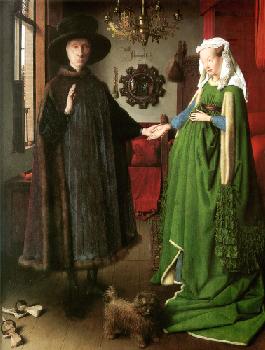
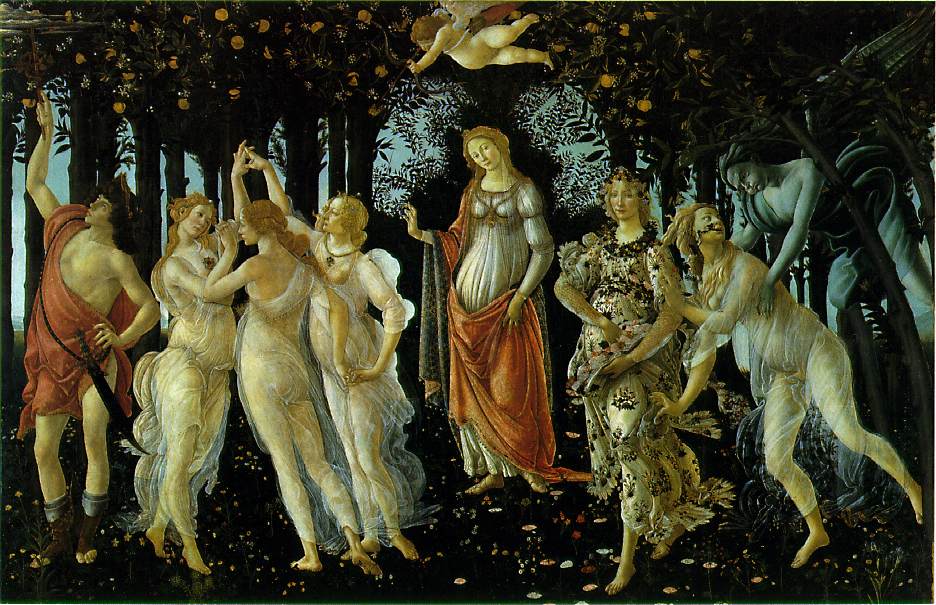
In the 15th and 16th centuries, Italy occupied a time and place which saw a flurry of activity in philosophy, politics, science, literarture, and particularly art. Between the years of 1425 and 1430, Robert Campin created his Merode Altarpiece* in Flanders while Jan Van Eyck worked his way up to the creation, in 1434, of his masterpiece The Marriage of Giovanni Arnolfini; Botticelli created his masterpieces La Primavera and The Birth of Venus between 1482 and 1486; Michelangelo carved his Pieta somewhere between 1498 and 1500, his David between 1501 and 1504, and decorated the ceiling of the Sistine Chapel** from 1508 to 1512; Raphael and Titian were coming into their own after 1509 and 1511, respectively; writers such as Piero della Francesca, Marsilio Ficino, and Politian were formulating their theories on existence and ethics; the monk Savanarola was executed for heresy in 1498; the French invaded Italy in 1494; the Turks occupied Southern Italy; the Medici were deposed and exiled from Florence, Italy in 1494 then regained power in 1512; Machivelli set to writing his treatise to the young Lorenzo de'Medici, which was to be published posthumously in 1532. Not a very healthy environment in which the arts could flourish by any stretch of the imagination.
But flourish, they did. However, it wasn't until the late 1530s that court theatre really thrived in Italy, as it did under the Medici Grand Dukes, enthroned at the Italian capital of Florence, from 1539-1637.(1)
The theatre festivals, staged under the Medici, were produced for many reasons: To celebrate court weddings and to entertain visiting dignitaries, or even to alert rival courts to the Medici's domination and importance; but they also produced general entertainments for the population at large. Also, there were several different forms of these entertainments, from pageant-jousts performed "within a framework of Chivalric or Oriental allegorical fantasy" to the first operas, to the inclusion of mock duels enacted by the courtiers, as well as tournaments in which the courtiers could also participate.(2) There were also the popular court ballets, which consisted of little dramatic force, much operatic action, all of which could be stopped at any moment in order for the aforementioned ballet or stylized combat to unfold.(3)
At first, plays were relatively straightforward with musical interludes called intermezzi "serving as intermission features".(4) This particular form of drama was employed from 1539 to 1589; and although playwrights were patroned to pen the dramas, composers were called in separately for the production of the intermezzi. Such noted composers as Ottavio Rapuccini, Giulio Caccani, and Jacopo Peri were hired to produce operas for the Dukes(5) such as for the wedding of Maria de'Medici(6), while men such as Alessandro Stiggio, Francesco Cortecia, and Cristofano Malvezzi were employed for the creation of lush madrigals. Opera developed into a full-fledged form in the Florentine courts in 1600 with Peri's Euridice, and Caccini's Il Rapimento di Cefalo and except for a brief revival of the earlier form--that is, plays interspersed with intermezzi--opera became the mainstay of Italian theatre.(7) Such noted artists as Bastiano da San Gallo, Giorgio Vasari, and Giulio Parigi designed sets for these entertainments.
But these performances were not solely staged in the closed confines of the Ducal palaces. Plays were performed in the courtyards of the Dukes' elaborate homes, in the homes of their colleagues (the Pitti opened their gardens up to such courtly productions on three separate occasions--"the Sabarra of 1579, the mock battles...of 1589, and for the production of the opera Le Nozze degli dei in 1637."(8)), in the streets, and even annually, on the Arno River, such as was the case with the Argonautica a naval show staged in 1608 which was "considered the greatest naval show ever staged on that river".(9) Performances were staged in the streets, as stated above, in order to welcome brides, such as Marie de'Medici, as they arrived for their weddings.(10)Carnival season was another reason for elaborate performances. During this occasion, races would be run in the Via Larga and the Via Maggio (the two main streets in Florence). Parades, too, were a mainstay of the Carnival, populated by elaborate floats topped with men and women sporting costumes, which for the Carnival of 1566 were designed by the inimitable Giorgio Vasari, being based on those of the Ancient Romans and Greeks.(11)
And of course, there were public spaces for such entertainments; for example, a temporary playhouse was erected in the Palazzo Vecchio (the Florentine High Court building) on three separate occasions: in celebration of the marriage of Francesco de'Medici I where Vasari's La Cofanaria and its intermezzi were performed; and twice by Baldassare Lanci in 1568 and 1569. "After each production, the stage... and the degrees forming the auditorium were dismantled"(12) for the continuance of the political duties the following day. In 1586, a permanent theatre was built for the Medici. Called the Teatro Uffizi and "[d]esigned by Bernardo Buontalenti, the hall had a capacity of between three and four thousand people. The Grand Duke and his guests would sit on a dais in the center of the theatre, the ladies were seated on degrees all along the side walls, the men took their places on the raked floor, while persons who preferred to remain incognito watched the spectacle through the windows of the Galleria, which housed the Grand Duke's art treasures." (13)
Such entertainments as have been described were very expensive affairs for the Dukes to patron, but they had their political uses. These events were a form of flattery from the producers and composers to the Medici, almost always referring to the Grand Duke and his gracious nature somewhere in the compositions. Also, they were elaborate and expensive forms of Ducal conceit; a desire to demonstrate their importance to their fellow dukes and princes, and were just the thing to take the Dukes' minds off the harsh reality facing them the next day in the mundane, yet elaborately appointed halls of Florentine society.
Essay copyright 1999-2012, Webmistress;
slightly revised 2003
Back to Site Index
~*~*~*~
NOTES:
(1): putting aside, for the moment, the development of the art in Milan under Isabella d'Este
(2): Nagler, p. 2
(3): ibid.
(4): ibid.
(5): Nagler p. 1
(6): Blumenthal p. 27
(7): Nagler p. 2
(8): ibid p. 3
(9): ibid p 2
(10): ibid p 1
(11):ibid p 2
(12): ibid p. 3. Degrees: Risers, seats for the audience.
(13): ibid
*For more information on Campin's masterpiece see, this wonderful site: The Merode Altarpiece
**For more information on the Sistine Chapel, see The Web Gallery of Art's Sistine Index
Scroll Back To The Top
Background tile by webmistress. Made exclusively for Raven Queen's Domain. copyright 2006 and beyond; please do not snag.